If you've spent any time this year reading about Florida roof insurance rules, you've probably run into the claim that a new law took effect on July 1, 2026, stopping insurers from dropping homeowners over an aging roof. It's on contractor blogs. It's on lending sites. It's repeated with confidence, complete with bill numbers.
It isn't true. Senate Bill 808 and its House companion, HB 815, both died in committee on March 13, 2026, months before the date they were supposedly going to take effect. For anyone selling or buying a century-old home in North Hill or Old East Hill, that distinction matters more than most, because in these two districts a roof decision was never just an insurance decision. It runs through a second approval process that has nothing to do with Tallahassee and everything to do with the City of Pensacola.
The Bill That Died in March
SB 808 and HB 815 would have expanded Florida's roof-age insurance protections to cover all residential property policies, not just standard homeowner's forms, and would have widened who qualifies as an authorized roof inspector. Both bills carried a proposed effective date of July 1, 2026, which is almost certainly why so many summaries treat that date as settled fact. The Florida Senate's own bill tracker shows the real outcome: both measures died in the Insurance and Banking committees on March 13, 2026, and neither one became law.
That correction isn't a technicality. If you're a seller getting non-renewal language from a carrier and you cite a law that never existed, you've weakened your own position at exactly the moment you need to be precise.
What's Actually Protecting You Right Now
The rule that does apply came out of the 2022 legislative reforms, not 2026. Florida Statute 627.7011, amended that year, prohibits an insurer from refusing to issue or renew a homeowner's policy solely because a roof is under 15 years old. Once a roof crosses that 15-year line, the insurer can require an inspection, but the homeowner has the right to submit a report from an authorized inspector showing at least five years of remaining useful life, and if that report holds up, the carrier has to keep the policy in force. House Bill 1611, effective in July 2024, widened the list of who counts as an authorized inspector to include licensed roofing contractors alongside home inspectors, general contractors, engineers and architects.
Here's how that plays out by roof age:
| Roof age | What the law allows | What you'd need |
|---|---|---|
| Under 15 years | Insurer cannot deny or non-renew based on age alone | Nothing extra beyond the standard policy |
| 15 years or older | Insurer can require inspection before renewal | A remaining-useful-life report from an authorized inspector showing 5+ years left |
That's the whole rule. No new 2026 statute changed it, and none is currently scheduled to.
In North Hill, the Roof Answers to a Second Board Too
North Hill is listed on the National Register of Historic Places and protected under Section 12-2-10 of the Pensacola Municipal Code, with oversight from the city's Architectural Review Board. Old East Hill sits under a parallel set of rules. The Architectural Review Board doesn't just look at additions and paint colors. Its charge covers the exterior appearance of a property in full, including the roof, and any permit to alter, replace or repair that exterior has to clear the board first.
This isn't theoretical. In February 2025, the board spent real time on a new-construction home on North Barcelona Street, debating whether a steeper roof pitch could be approved as an ornamental exception to the height code so the house would read as authentically Victorian rather than compressed to fit a modern height cap. In April 2025, a restoration at a contributing structure on North Spring Street got initial approval with a condition attached: the applicant had to come back with more detail on how a new porch roof would attach without damaging the home's original cornice work. The North Hill Preservation Association's own project archive references a full roof replacement at a home on North Barcelona following a fire, handled through the same review path.
None of that runs on the insurer's clock. The Architectural Review Board doesn't know or care what your carrier's renewal date is, and your carrier's underwriting department has no visibility into whether your roof replacement needs a second look from the city before a permit is issued. They're two separate processes moving at two separate speeds, and the homeowner is the only party tracking both.
What the Two Clocks Cost, in Dollars and Weeks
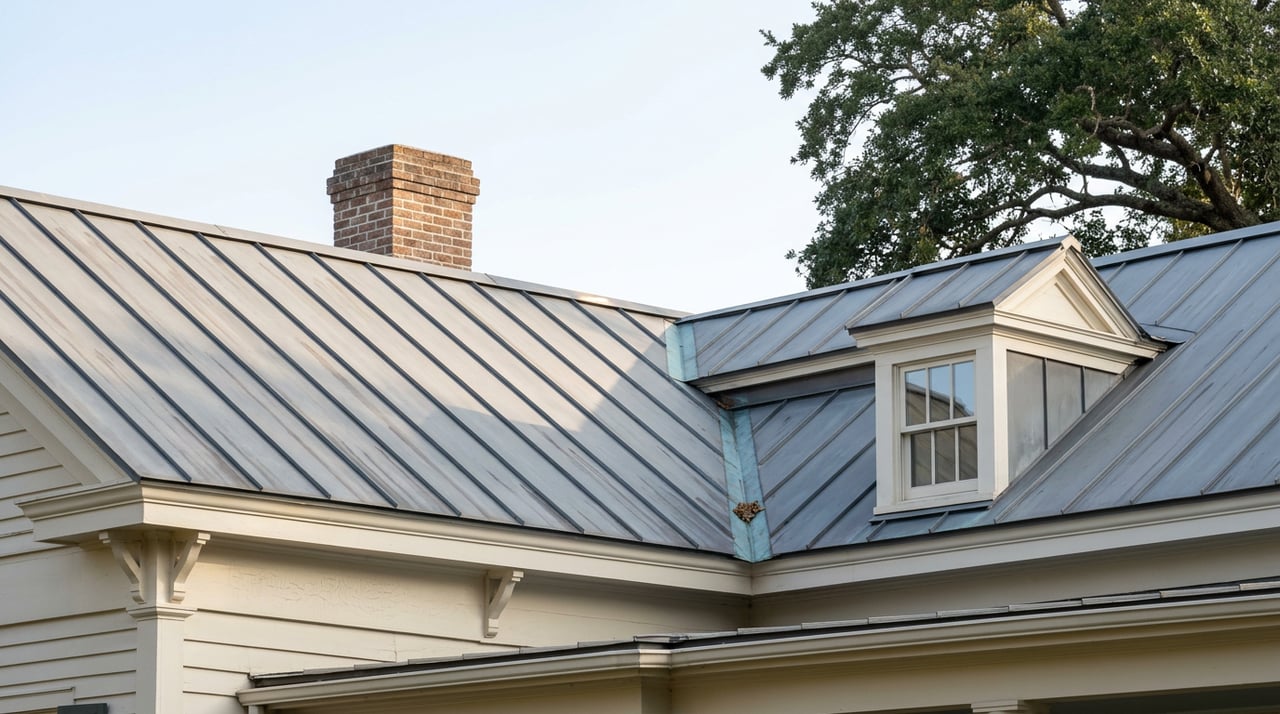
Roof replacement pricing in the Pensacola area in 2026 runs roughly $9,000 to $18,000 for a standard architectural shingle roof and $16,000 to $28,000 for standing-seam metal, according to current local contractor pricing. In a historic district, the choice isn't purely about budget or longevity. If your home's original roof was standing-seam metal, the Architectural Review Board's review of "materials, textures and colors" under the preservation district guidelines means a like-for-like metal replacement, matched to the original panel profile, is often the path that clears review without a fight. That's a specialty scope, not a commodity one, and it shows up in both the estimate and the calendar.
The calendar is the part that catches people off guard. An insurance remaining-useful-life inspection can happen in a day. Architectural Review Board approval, especially for anything beyond a straightforward like-for-like swap, has taken weeks in recent cases, sometimes longer when the board asks for revised drawings, as it did on the North Spring Street project. If you're a seller who just got a 15-year roof-age letter from your carrier and a buyer who's counting down a standard inspection contingency, those two timelines rarely line up on their own.
Reading This Correctly If You're Listing or Under Contract
If you own a historic-district home with a roof approaching or past 15 years, the sequence matters more than any single fact above.
- Order the remaining-useful-life inspection first, from an authorized inspector, before you list or before your buyer's contingency clock starts. Having that report in hand removes the insurance question from the table entirely if the roof qualifies.
- If the roof doesn't qualify and replacement is the real answer, start the Architectural Review Board application in parallel with getting contractor bids, not after you've already chosen a contractor. The board reviews the plan, not just the finished product.
- Build extra runway into any inspection contingency on a historic-district contract. A generic 15-day period written for a non-historic subdivision may not leave room for both an insurance inspection and a preservation review if the roof needs replacing rather than certifying.
None of this is a legal requirement unique to North Hill. It's a sequencing problem, and sequencing problems are exactly what a good pre-listing consultation is supposed to catch before they become a delay at the closing table.
FAQ
Does the 15-year roof rule apply outside North Hill and Old East Hill? Yes. Florida Statute 627.7011 applies statewide to standard homeowner's policies regardless of neighborhood or historic status. The Architectural Review Board layer is what's specific to Pensacola's designated historic districts.
If my roof is under 15 years old, do I still need Architectural Review Board approval to repair storm damage? Age doesn't exempt you from historic district review. Any exterior repair or alteration in North Hill or Old East Hill, regardless of the roof's age, goes through the same city process before a permit is pulled.
Who counts as an authorized inspector for the remaining-useful-life report? Under current law, that includes licensed home inspectors, general contractors, licensed roofing contractors, professional engineers and architects.
If you're weighing a sale or a purchase of a historic Pensacola home and want to know exactly where your roof stands with both the insurer and the Architectural Review Board before you list or make an offer, that's precisely the kind of groundwork Peggy Braun walks clients through, drawing on two decades of renovation experience alongside full-service brokerage. Reach out for a free home valuation and design consultation before your timeline gets set for you.